Showing posts with label red-gray chips. Show all posts

Thursday, February 28, 2013

7.5 kJ/g disproves thermitic material

Abstract

Harrit et al. [1] present 4 red-gray chips that they did a DSC test on. One of the chips was determined to yield a specific energy of 7.5 kJ/g. They believe that some of that energy yield comes from thermite in the red layer.

Assuming that the red layer contains at least as much Si as Al by weight and that Si is fully oxidized as SiO2, I have developed a simple spreadsheet to compute the minimum amount of energy that the organic matrix must contribute to raise the composite specific energy of the chip to the empirical value of 7.5 kJ/g. A number of cases is dicussed in which the following paramters are varied:

  • Specific energy of thermite: Theoretical value of 3.96 kJ/g vs. a more realistic practical value of 3 kJ/g
  • Mass of the gray layer: None vs. equal mass as red layer (this in effect doubles the effective specific energy of the red layer)
  • Organic matrix: Values of 42 kJ/g (highest tabulated value of all organic polymers, for PP), 30 kJ/g (upper limit for most polymers), 20.4 kJ/g (epoxy) and 9.5 kJ/g (ideal polymer plus oxidizer composite) are considered.

Introduction

According to the data in [1] and Harrit et al.'s interpretation thereof, the red layer of their red-gray chips contains mainly just the elements C, O, Al, Si and Fe, while the gray layer is mainly iron oxide and chemically inert. They conclude that the red layer contains thermite (2 Al + Fe2O3) which reacts in the DSC test, and also an unidentified organic matrix that also reacts and is "itself energetic" (p. 28). Harrit et al. have heated four chips in a DSC up to 700 °C and measured heat flux. The most energetic of these four yielded a specific energy of 7.5 kJ/g (page 19):

Proceeding from the smallest to largest peaks, the yields are estimated to be approximately 1.5, 3, 6 and 7.5 kJ/g respectively. Variations in peak height as well as yield estimates are not surprising, since the mass used to determine the scale of the signal, shown in the DSC traces, included the mass of the gray layer. The gray layer was found to consist mostly of iron oxide so that it probably does not contribute to the exotherm, and yet this layer varies greatly in mass from chip to chip.

Later (p. 28) they correctly argue:

We observe that the total energy released from some of the red chips exceeds the theoretical limit for thermite alone (3.9 kJ/g). One possibility is that the organic material in the red layer is itself energetic.

When the chip as a whole exhibits 7.5 kJ/g, but it has constituent materials that are inert or have a lower energy density, then there have to be other constituents with an average specific energy that is significantly higher than 7.5 kJ/g. This already rules out conventional monomolecular explosives (Fig. 30 in [1]). So if the energy balance comes from the organic matrix, it has to react with an oxidizing agent: Either ambient oxygen, or, conceivably, some unidentified embedded oxidizer.

With reasonable assumptions to envelop ideal and realistic scenarios, it is possible to compute, dependent on hypothetical thermit contents, the minimum contribution of the organic matrix to the mass and energy yield of such a chip. I propose that, if significantly more of the energy yield comes from organic combustion than from thermite, then the characterization of the chips as "thermitic" as well as the interpretation of the DSC test results vis-a-vis nanothermite from literature are faulty.

Assumptions

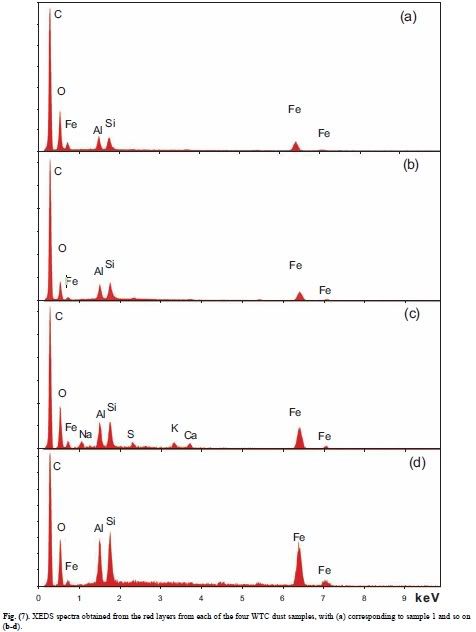
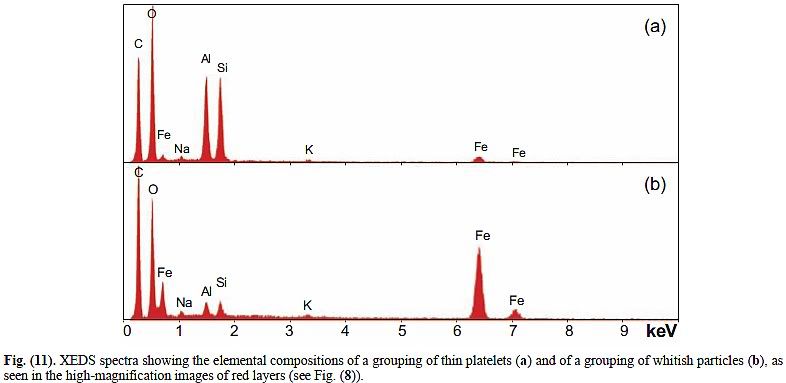
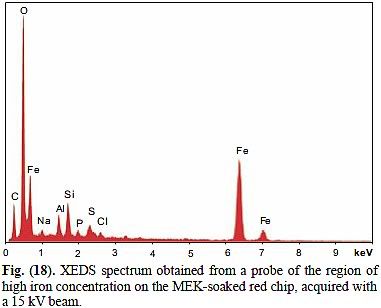
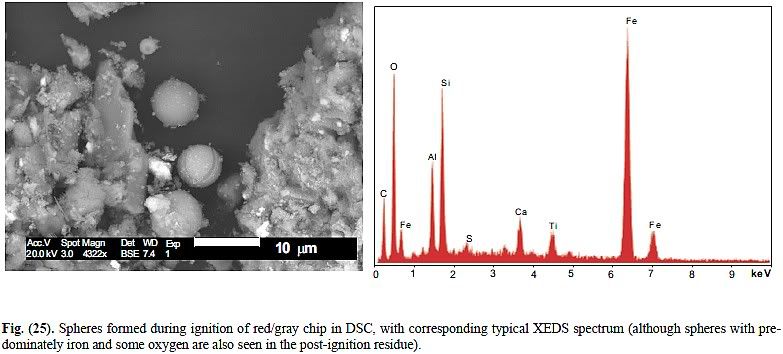
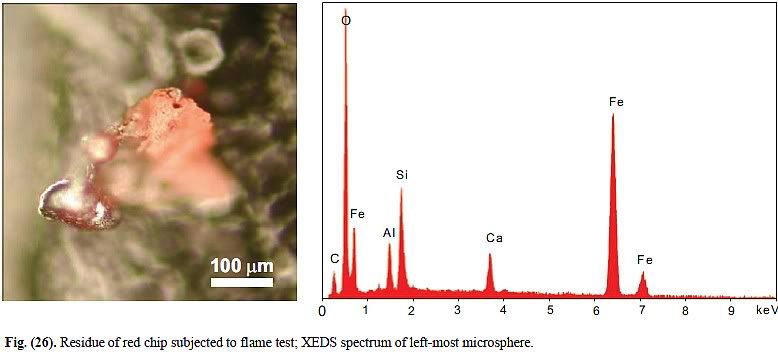
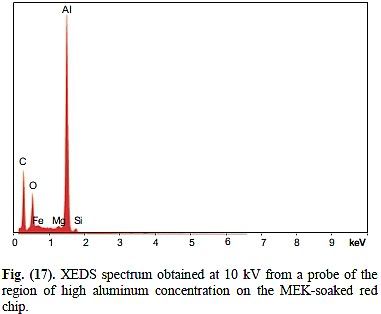
It is known from practically all EDS spectra of red layers or residues that Harrit et al. present that the silicon amount is at least equal to, and often exceeds, the aluminium content. This is easy to verify: In Fig. 7, and Fig. 11, the Al- and Si-peaks are about equal, in Fig. 14, 16, 18, 25 and 26, the Si-peak is significantly higher than the Al-peak. The only exception, Fig 17, is from a small spot location specifically chosen for its high Al-content. That chip however contains less Al overall than Si (Fig. 14). Judging from Fig. 16 I find that Si is accompanied by enough O to form silica.

I will therefore assume that, for all chips tested in the DSC,

  • Si was present in the red layer in a mass fraction equal to that of Al.
  • Si is fully oxidized as SiO2. Since Si and O appear in silica in a mass fraction of 28:(16+16), this means that for each mass unit of Al, there are 32/28 = 1.14 mass units of O.

These are the only assumptions that are not "thermite friendly", but they follow from the data! I have three more assumptions that remain constant throughout all cases and that are either "thermite friendly" (i.e. deviation from them would render the case for Harrit et al.' "thermite" hypothesis even more unrealistic), or almost neutral:

  • I assume in all cases cases that all the Al is mixed with iron oxide as stoichiometric thermite: 2 Al + Fe2O3 (molar masses 2*26.98 + 159.69) consists of 74.7% iron oxide and 25.3% Al, so for each mass unit of thermite, there are 0.253 mass units of Al and 0.541 mass units of SiO2 (0.253 + 0.253*32/28).
  • The balance of the mass of the red layer is assumed to be organic material, with or without embedded oxidizer.
  • The gray layer is always present and assumed by Harrit et al. to not contribute to the exotherm. I disagree somewhat with this assumption - it is quite possible for hematite to experience exotherm phase changes when heated, but that will pale against redox reactions of fuel, so I ignore that and accept the assumption.

Parameters and cases

It is well known that many solid organic compounds, including many that could form such a matrix (epoxy, alkyd, other resins) are highly energetic. Practically all of them release more than the 3.96 kJ/g that thermite does. For non-halogenated polymers (Harrit et al. found no significant signals for halogenes), tabulated values for effective heat of combustion range from 12.0 kJ/ for Polyimide thermoplastic over 20.4 kJ/g for epoxy and around 25.5 kJ/g for Polyamides to 41.9 kJ/g for Polypropylene ([2], Table A-5). The large majority are in a range between 15 and 30 kJ/g. Itherefore propose that the effective specific energy of the unknown organic material cannot exceed 42 kJ/g, and probably does not in fact exceed 30 kJ/g. I will further consider the case that the matrix is epoxy, as Millette found chips with an epoxy matrix.

The previous paragraph considers organic combustion with oxygen from ambient air. Such a process limits the burn rate and would render the red layer material less-than-explosive. I will consider a hypothetical polymer readily mixed with pure oxygen as oxidizer: The highest energy yield is tabulated for Polypropylene (PP), at 42 kJ/g. PP has a sum formula of (C3H6)n. Complete combustion follows the formula: C3H6 + 4.5 O2 -> 3 CO2 + 3 H2O + heat. This means that a composite of PP and O2 would have to incorporate 144 (9*16) g of oxygene per 42 grams of PP. The effective specific energy of that composite would consequently drop to 42 kJ/g * 42/(42+144) ~ 9.5 kJ/g. Of course any actual solid oxidizer (such as perchlorates or permagnanates) contains additional mass that would further decreases the effective specific energy. I will use 9.5 kJ/ as an upper limit to envelop any and all (organic polymer + oxidizer) composites.

I will assume in the ideal case that all the Al is present as metal, none is oxidized, and that it reacts perfectly with all the available iron oxide to release the theoretical maximum of 3.96 kJ/g. In a more realistic case, I will assume the same proportions of aluminium and iron oxide, but consider that a sgnificant proportion of nano-Al is passivated, or that it won't react to completion, such that the effective energy yield of the thermite is decreased to 3 kJ/g.

The mass proportions of red:gray layers isn't known and difficult to estimate. However, as the gray layer is mostly iron oxide (>5 kg/L) and the red layer is only partly iron oxide, all other constituents lighter (Al: 2.7 kg/L; silica: 2.65 kg/L; polymers: usually <2 kg/L), it is clear that the gray layer has a significantly higher density. Harrit suggest that both layers are usually of similar thickness. In my unrealistic cases, I will ignore the gray layer, or assume its mass is 0, in the realistic cases I'll assume both layers have the same mass. That effectively doubles the specific energy of the red layer, from 7.5 to 15 kJ/g.

Calculations

Formulas

I created a spreadsheet with five input cells (numbers (1), (2), (6), (7) and (9) below) and with six relevant output cells (numbers (4), (5), (11), (13), (14), (15) and (17) below). The formulas provide a generic description of the spreadsheet formulas, so you can recreate the spreadsheet with any software you prefer:

(1) The mass of the red layer is constant: 100%.
(2) The mass proportion of thermite in the red layer, expressed in %
(3) The mass proportion of Al in the red layer: =(2)*0.253
(4) The mass proportion of SiO2 in the red layer: =(3)*60/28
(5) The mass proportion of the organix matrix is the balance: =(1)-(2)-(4)
(6) The specific energy of thermite: In the "ideal" case 3.96 kJ/g, in the "realistic" case 3 kJ/g
(7) The mass of the gray layer: In the "ideal" case 0, in the "realistic" case 100% (of the red layer)
(8) Total mass of the Chip: =(1)+(7)
(9) The measured specific energy of the chip, in kJ/g; constant at 7.5 kJ/g for the purpose of this article
(10) The specific energy of the red layer alone: =(9)*(8)/(1)
(11) The contribution of thermite to the specific energy of the red layer in kJ/g: =(6)*(2)
(12) The contribution of the organic matrix to the specific energy of the red layer in kJ/g: =(9)-(11)
(13) The specific energy of the organic matrix: =(12)/(5)
(14) The mass ratio of organics:thermite: =(5)/(2)
(15) The energy contribution ration of organics:thermite: =(12)/(11)
(16) The energy contribution of thermite, in % of total energy release: =(11)/(9)
(17) The energy contribution of organics, in % of total energy release: =(12)/(9)

For each of the three cases, I kept the specific energy of thermite (6) and the mass of the gray layer (7) constant and played with the mass proportion of thermite (2) such that the specific energy yield of the organic matrix (13) reached the target values of 9.5, 20.4, 30 and 42 kJ/g. I then copied the resulting values of interest into the tables.

Tabulated results

I have modeled three cases - one unrealistic, one half realistic, one realistic. In each case, I have tabulated results for 5 mass proportions of thermite:

  1. Thermite fixed at 12%. This means an Al-content just over 3%. I chose this value, as quantifications of XEDS spectra of red layers suggest there is less than 3% Al in them
  2. Thermite chosen such that the organic matrix computes to the specific energy yield of 9.50, which is a theoretical upper limit for organic polymer with embedded stoichiometric oxygen
  3. Thermite chosen such that the organic matrix computes to the specific energy yield of epoxy, 20.40
  4. Thermite chosen such that the organic matrix computes to the specific energy yield of 30 kJ/g, which is a realistic limit defined in my assumptions
  5. Thermite chosen such that the organic matrix computes to the specific energy yield of 42 kJ/g, which is the maximum for all organic polymers

Ideal case: Gray layer 0%, Thermite 3.96 kJ/g, chip yields 7.5 kJ/g

"Ideal" means "unrealistic" - this case gives absolute theoretical maxima for the contribution of thermite to the measured exotherm. It is however impossible to actually reach these values, as the energy yield of thermite in practice never reaches the theoretical maximum of 3.96 kJ/g, and there was in fact a gray layer that contributed significant mass but no significant energy.

Mass of
Thermite
% of red layer
(2)
Mass of
SiO2
% of red layer
(4)
Mass of
Organics
% of red layer
(5)
Contrib.
Thermite
kJ
(11)
Yield of
Organics
kJ/g
(13)
Mass
Thmt:Poly

(14)
Energy
Thmt:Poly

(15)
Contrib.
Polymer
%
(17)
12.00 5.69 82.31 0.48 8.53 1:6.86 1:14.78 93.66%
19.90 9.44 70.66 0.79 9.50 1:3.55 1:8.52 89.49%
49.39 23.43 27.18 1.96 20.40 1:0.55 1:2.83 73.92%
55.87 26.50 17.63 2.21 30.00 1:0.32 1:2.39 70.50%
59.52 28.23 12.25 2.36 42.00 1:0.21 1:2.18 68.57%

More realistic case: Gray layer 0%, Thermite 3.00 kJ/g, chip yields 7.5 kJ/g

"More realistic" means "still unrealistic" - The thermite yield is now reasonable, but I still ignore the very real mass of the gray layer.

Mass of
Thermite
% of red layer
(2)
Mass of
SiO2
% of red layer
(4)
Mass of
Organics
% of red layer
(5)
Contrib.
Thermite
kJ
(11)
Yield of
Organics
kJ/g
(13)
Mass
Thmt:Poly

(14)
Energy
Thmt:Poly

(15)
Contrib.
Polymer
%
(17)
12.00 5.69 82.31 0.36 8.67 1:6.86 1:19.83 95.20%
18.20 8.63 73.17 0.55 9.50 1:4.02 1:12.74 92.72%
47.64 22.60 29.76 1.43 20.40 1:0.62 1:4.25 80.94%
54.57 25.89 19.54 1.64 30.00 1:0.36 1:3.58 78.17%
58.55 27.77 13.68 1.76 42.00 1:0.23 1:3.27 76.58%

Realistic case: Gray layer 100%, Thermite 3.00 kJ/g, chip yields 7.5 kJ/g

"Realistic" means that all assumptions are now within the bounds of what is possible in practice - it does not mean that these are probable values! Al still ist best estimated as less than 3% of the mass of the red layer! This case merely provides realistic maxima of hypothetical thermite contribution to mass and energy yield af that chip and its 7.5 kJ/g.

Mass of
Thermite
% of red layer
(2)
Mass of
SiO2
% of red layer
(4)
Mass of
Organics
% of red layer
(5)
Contrib.
Thermite
kJ
(11)
Yield of
Organics
kJ/g
(13)
Mass
Thmt:Poly

(14)
Energy
Thmt:Poly

(15)
Contrib.
Polymer
%
(17)
12.00 5.69 82.31 0.36 17.79 1:6.86 1:40.67 97.60%
n/p n/p n/p n/p 9.50 n/p n/p n/p
19.95 9.46 70.59 0.60 20.40 1:3.54 1:24.06 96.01%
36.38 17.26 46.36 1.09 30.00 1:1.27 1:12.74 92.72%
45.82 21.74 32.44 1.37 42.00 1:0.71 1:9.91 90.84%

Discussion

The first, fully unrealistic case, shows that even under the most thermite-friendly assumptions - the highest possible energy contribution of the organic matrix and ideal composition of thermite, with no losses, and neglected gray layer mass, the organic matrix provides more than twice as much energy as the hypothetical thermite. In the case of a more typical or expected epoxy matrix, this factor increases to almost 3. If XEDS readings are reliable in their indicating 3% of Al or less, then the organic matrix provides at least 93.66% of the measured energy, or almost 15 times as much as thermite.

When we consider that nanothermite can't in practice yield the theoretical maximum but will in practice be limited to perhaps 3 kJ/g, then even the best, most "thermite-friendly" organic matrix would contribute 76.58% of the measured energy, which is more than 3 times the energy that thermite contributes in that case - even when the gray layer is ignored. If the matrix is epoxy, then thermite would only contribute 21% of the energy. If the polymer carries its own oxidizer, then it must contribute more than 4 times the mass of thermite and more than 12.7 times more energy.

Putting the gray layer into the equation, the last remaining hope that thermite could play a significant role is shattered: The best realistic case, with an organic matrix that has 42 kJ/g, there could be almost 46% thermite in the red layer, but it would contribute only 11% of the energy. A more typical organic material with 30 kJ/g would have to outweigh the thermite by mass and yield 92.72% of the total energy. An epoxy matrix would have to outweigh thermite by a margin of 3.54:1, giving it 24 times the energy content of the 20% thermite. However, as there probably isn't actually more than 3% Al in the red layers, which means no more than 12% thermite, we find that 7.5 kJ/g for the entire chip means that 97,60% of its energy must come from organic combustion.

The spreadsheet shows that, as long as the gray layer has more than 26.5% of the mass of the red layer. it is not possible at all to reach 7.5 kJ/g with an ideal hypothetical (polymer+O) composite that is independent from ambient air, regardless of thermite content (nor can thermite, with its mere 3.96%, explain that value).

Since in all realistic scenarios, no more than 36% of the mass of the red layer would be thermite, and that thermite would be intimately mixed with silica and organic matrix in a nanocomposite with a very high surface-to-volume ratio, we have to assume that the heat released by both the thermite and the organic matrix would increase the temperature of all ingredients uniformly. A significant proportion of that heat is lost in gasification of the organic polymer. It seems unlikely that any part of such a mix could reach a temperature near the melting point of iron, as Harrit et al. seem to suggest (page 19).

Conclusions

With only two limiting assumption - that there is as much Si as Al, and that it is fully oxidized to silica - I have shown that the theoretical maximum contribution of thermite is under 1/3 of the energy yield of that chip. This result of just 31.43% energy from thermite holds true only for a carefully chosen but impossible set of conditions: Perfect efficiency of the thermite, no mass contribution from inert gray layer, and the most energetic solid organic polymer fuel.

Considering realistic parameters - that the hypothesized nanothermit will yield no more than 3 kJ/g (about 75% of the theoretical maximum) in practice, and that the gray layer has the same, but chemically inert, mass as the red layer, I find that the organic matrix must contribute at least ten times as much energy as thermite. This factor of ten holds true only with an ideal organic fuel. A realistically chosen organic fuel, with a specific energy between 20 and 30 kJ/g, would have to have 1.27 to 3.54 times the mass of thermite, and contribute 92.7 - 96.0% of the energy to boost that chip to its empirically determined 7.5 kJ/g. In these scenarios, the thermite content falls to 20%

Considering that the actual Al-content of the red layers is probably under 3%, I find that thermite can at most contribite 2.4% of the 7.5 kJ/g

It is not within the realm of the practically possible to hypothesize that the organic matrix itself contains an embedded oxidizer.

With those findings, this red-gray chip cannot reasonably be called "thermitic" and cannot be explosive.

References

[1] Harrit N. H.; Farrer, J.; Jones, S. E.; Ryan, K. R.; Legge, F. M.; Farnsworth, D.; Roberts, G.; Gourley, J. R.; and Larsen, B. R.: Active Thermitic Material Discovered in Dust from the 9/11 World Trade Center Catastrophe. The Open Chemical Physics Journal, 2009, 2, 7-31

[2] Lyon Richard E.; Janssens Marc L.: Polymer Flammability. May 2005 - Final Report for the U.S. Department of Transportation and FAA. Report No. DOT/FAA/AR-05/14

Thursday, March 22, 2012

Comparison of Gray Layer XEDS by Harrit vs. Millette

Abstract

Harrit e.al. [1] and Millette [2] both examined the gray layers of red-gray chips found in the WTC dust using XEDS. This article will show that all nine gray layers are probably oxidized steel, with no significant differences in the level of oxidation between the two publications. However, while Harrit's four samples may well be the same steel alloy, Millette's seem to be different steel alloys. Perhaps one of Millette's specimens is of identical or similar steel as Harrit's.

Introduction

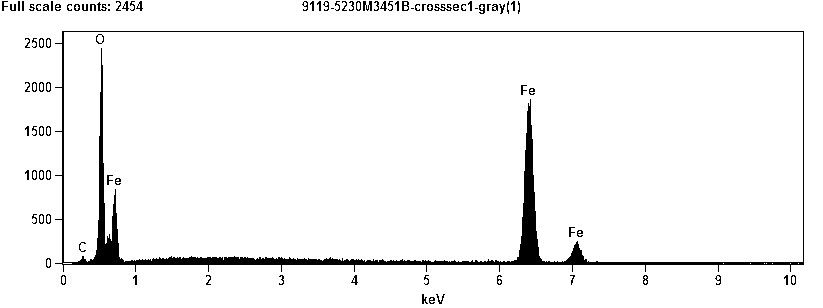
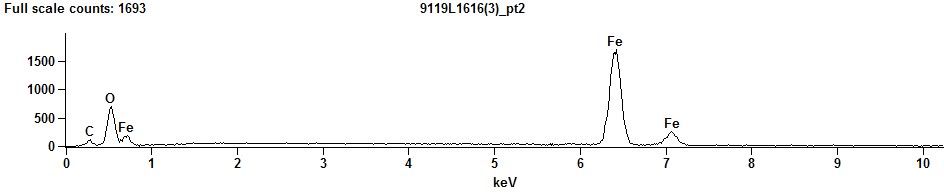
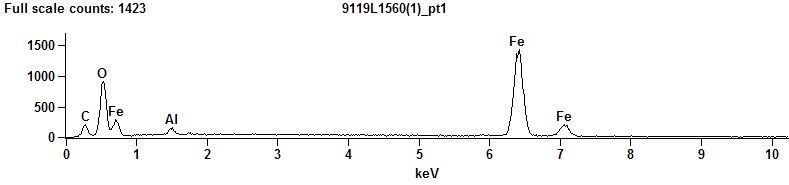
I measured the XEDS graphs of gray layer material thus far published by Harrit e.al. and Millete. Here are links to the bitmaps:

Harrit e.al.: Chips (a) – (d)

Millette: 9119X0135(3)_pt2, 9119-5230M3451B-crosssec2-gray(1), 9119-5230M3451B-crosssec1-gray(1), 9119-4808L1616(3)_pt2, 9119-4795L1560(1)_pt1

The following Table lists the peak height in pixels:

Element

C

O

Fe

Al

Mn

Fe

Fe

Level


K

L-a

K-a

K-a

K-a

K-b

Edge Energy (keV)


0.54

0.84

1.49

5.9

6.4

7.08

Millette's gray layers:


9119X0135(3)_pt2

5

23

10

4

0

88

13

9119-5230M3451B-crosssec2-gray(1)

7

201

64

0

0

215

29

9119-5230M3451B-crosssec1-gray(1)

7

215

74

0

0

164

22

9119-4808L1616(3)_pt2

7

41

11

0

0

97

15

9119-4795L1560(1)_pt1

13

56

18

10

0

88

13

Harrit's gray layers:


Chip (a)

20

266

98

0

10

322

45

Chip (b)

32

335

127

0

9

326

48

Chip (c)

30

320

144

0

0

215

32

Chip (d)

33

324

140

0

11

309

43


I then computed the relative peak heights, using a formula (Individual peak height) / Sum(all peaks in the same line). So for example, in Sample Chip (a), C has a pixel height of 20px, and the sum off all pixel heights is (20+266+98+0+10+322+45), and thus relative peak height of C would be 20 / (20+266+98+0+10+322+45) = 2.63%. With this crude method, I normalize the different absolute dimensions of the graphs. Here's the result:


Element

C

O

Fe

Al

Mn

Fe

Fe

Level


K

L-a

K-a

K-a

K-a

K-b

Edge Energy (keV)


0.54

0.84

1.49

5.9

6.4

7.08

Millette's gray layers: (This line: Arithmetic mean)

3.39%

30.38%

10.05%

1.57%

0.00%

47.68%

6.92%

9119X0135(3)_pt2

3.50%

16.08%

6.99%

2.80%

0.00%

61.54%

9.09%

9119-5230M3451B-crosssec2-gray(1)

1.36%

38.95%

12.40%

0.00%

0.00%

41.67%

5.62%

9119-5230M3451B-crosssec1-gray(1)

1.45%

44.61%

15.35%

0.00%

0.00%

34.02%

4.56%

9119-4808L1616(3)_pt2

4.09%

23.98%

6.43%

0.00%

0.00%

56.73%

8.77%

9119-4795L1560(1)_pt1

6.57%

28.28%

9.09%

5.05%

0.00%

44.44%

6.57%

Harrit's gray layers: (This line: Arithmetic mean)

3.54%

38.50%

15.77%

0.00%

0.90%

36.11%

5.18%

Chip (a)

2.63%

34.95%

12.88%

0.00%

1.31%

42.31%

5.91%

Chip (b)

3.65%

38.20%

14.48%

0.00%

1.03%

37.17%

5.47%

Chip (c)

4.05%

43.18%

19.43%

0.00%

0.00%

29.01%

4.32%

Chip (d)

3.84%

37.67%

16.28%

0.00%

1.28%

35.93%

5.00%

Discussion

I notice that Millette's graphs tend to have relatively larger peaks on the high side of the energy spectrum than Harrit's: On average, the ratio between the K-alpha and L-alpha level of Fe in Millette's graphs is 47.68% / 10.05% = 4.74. In Harrit's samples, that ratio is 36.11% / 15.77% = 2.29 – less than half. Of course, both K-alpha and L-alpha represent the same amount of Fe per sample – the differences in relative peak height thus do not represent differences in relative element abundance. So in order to compare the Fe:O ratio, it would be wrong to compare O with the far-away Fe-K-alpha level. I think it is a better idea to compare O with the nearby L-alpha level of iron. These ratios are:


Sample

Ratio Fe(L-a) : O(K-a)

Millette's gray layers:

0.337

9119X0135(3)_pt2

0.435

9119-5230M3451B-crosssec2-gray(1)

0.318

9119-5230M3451B-crosssec1-gray(1)

0.344

9119-4808L1616(3)_pt2

0.268

9119-4795L1560(1)_pt1

0.321

Harrit's gray layers:

0.407

Chip (a)

0.368

Chip (b)

0.379

Chip (c)

0.450

Chip (d)

0.432


Here is a plot of the individual samples in both datasets, ordered from highest to lowest Fe:O ration within each set:

While the Fe:O ratio appears slightly lower in Millette's samples, the difference isn't major (on average, Harrit e.al. and Millette differ from each other by ~20%). In any case, Millette's gray layers would appear slightly more oxidized (higher Fe:O-ratio means lower O:Fe-ratio), assuming the relative heights of neighboring peaks can be compared across the studies. I conclude that the data provided by both Harrit e.al and Millette indicate the presence of iron that is oxidized to a comparable degree.

All samples also show some carbon. In Harrit's samples, the ratios C : Fe(L-alpha) are all within a narrow band from 0.204 to 0.252 (mean: 0.225), while Millette's scatter from 0.095 to 0.722 (mean: 0.413). I caution the reader that XEDS signals for C are very sensitive to many influences, and variation in the data doesn't necessarily reflect an equal degree of variation in abundance.

On the other hand, 2 of Millette's 5 samples show some Al, and none Mn, while 3 of Harrit's 4 samples show some Mn, but no Al.

Conclusions

It would appear that all 9 samples are consistent with oxidized carbon steel; but while Harrit may well have 4 samples from the same steel, it appears that Millette's specimens may be different steel alloys. I find it possible that the 9119-5230M3451B specimen may be the same, or a similar, steel that Harrit e.al. looked at, while the 9119X0135(3), 9119-4808L1616(3) and 9119-4795L1560(1) specimens are different steels on account of their Al-content and probably too high carbon content.

This finding

  • lends confidence to the belief that both Harrit an Millette looked at red-gray chips where the gray layer is oxidized structural steel and red the layer is mineral pigments in organic matrix

  • reinforces the suspicion that there are several different kinds of red-gray chips in WTC dust

  • highlights the need to carefully identify and distinguish these different kinds of red-gray chips before any particular conclusions or further study are contemplated.

References

[1] Niels H. Harrit, Jeffrey Farrer, Steven E. Jones, Kevin R. Ryan, Frank M. Legge, Daniel Farnsworth, Gregg Roberts, James R. Gourley and Bradley R. Larsen: Active Thermitic Material Discovered in Dust from the 9/11 World Trade Center Catastrophe. The Open Chemical Physics Journal, 2009, 2, 7-31. Figure 6.

[2] James R. Millette: Report of Results: MVA9119. Progress Report on the Analysis of Red/Gray Chips in WTC dust. Prepared for Classical Guide, Denver, 29 February 2012. Appendix D: SEM Analysis of Cross-Sections (20 kV)

Sunday, March 18, 2012

How Mark Basile confirms that red-gray chips are not thermitic

1. Abstract

Mark Basile has presented his analysis of red-gray chips he found in dust collected in lower Manhattan very shortly after the collapse of the World Trade towers on 2001/09/11 [1]. He concludes that his experiments confirm a similar but more comprehensive study published by Harrit e.al. [2]. Harrit e.al. have in turn accepted Basile's findings as confirmation of their conclusions: That the red-gray chips are thermitic in nature.

I will show that this conclusion is not warranted in any way. Instead, Basile's favorite specimen is organic by nature, with at most 1.3%, but perhaps 0%, of the heat of reaction coming from a thermite reaction, the balacnce, 98.7%-100%, from ordinary organic hydrocarbon combustion.

If this result is a “confirmation” of Harrit e.al., as 9/11 Truthers like to point out, then clearly this puts in grave doubt the affirmation that Harrit's chips were of thermitic nature.

2. Introduction

Mark Basile is a chemical engineer whose name is the second among those that Harrit e.al [2] thank for in their Acknowledgments (page 30). He held a videotaped presentation at the Porcupine Freedom Festival in Lancaster, New Hampshire on June 26th, 2010 at 4pm [1]. According to the presentation, between 30:00 and 31:26 minutes, he received a bag with “a few table-spoons” of dust collected by Janette MacKinlay in January 2008. Janette MacKinlay is also the contributor of dust sample 1 to Harrit e.al.

Basile isolated various dust particles from the sample, using a magnet and a petri dish, among them “iron based microspheres, Red/gray chips, Red chips, Rust, Wire”, also “Silicate or glassy spheres”. One particular red/gray flake, designated “#13” (he calls it “his lucky thirteen”), was photographed through a microscope, analyzed using XEDS and then heated till ignition, and the burning recorded on video through a microscope.

Basile found iron and aluminium atoms in the red layer, and concludes that the combustion he observed it probably thermitic.

3. The data

Here is the XEDS graph for chip # 13, shown at 39:30 in the video:

Photobucket

He explains that the table of weight-% values is derived from a standard software routine on the XEDS. I want to advise the reader to be careful with such derivations: The peak height or x-ray counts in XEDS spectra depend somewhat on a number of factors, such as surface and bulk geometry of the sample, and the presence or absence of materials that may tend to attenuate signals. The values aren't wrong, but remember that they come with a certain margin of error that is difficult to estimate.

Later in the presentation, between 41:43 and 42:00, Basile shows how such a red chip burns. I note his dramatic description of the event, but basically I just see something burning. So where does the heat of that reaction come from?

4. Discussion

Through most of this discussion, I will use the most “thermite-friendly” data and assumptions. By this I mean, I will take the data points where thermite ingredients were most abundant. I will assume that iron was indeed Fe2O3 and enough aluminium indeed elemental. I will assume that all of these intgredients contributed to a thermite reaction, with no losses and almost prefect execution. I will try to minimize the amount of hydrocarbons and its energy contribution so that the thermite reaction becomes as dominant as it can get.

4.1 Chemical composition - “thermite friendly”

The elemental composition that Basile shows in that table above translates into a mix of chemical compounds. Let's see what that mix looks like under the assumption that it contains the maximum amount of thermite, and minimum amount of other energetic compounds. To do so, I will use the weight-% figures in the first line, as the values for iron and aluminium, the main ingredients of thermite, are higher there.

Basile himself explains at 39:46:

In large part, it's an organic material of some sort

I agree fully: According to his quantification, more than 72% of the red layer are carbon. Basile knows that almost all of the carbon is bound with oxygen and hydrogen (and possibly other elements mixed in) to form hydrocarbons. This immediately means that more than 72% of the red layer is some kind hydrocarbon: Hydrocarbons also contain, as the name implies, hydrogen (H), which doesn't show up in an XEDS graph because it is too light. In many organic compounds, the molar (atom count) ratio of C:H is between 1:1 (for example Benzene, C6H6, which is a building block for many more complex molecules, including epoxies or TNT) and 1:2 (for example MEK, C4H8O, an organic solvant), which translates to mass ratios between carbon and hydrogen between 12:1 and 6:1. Staying on the careful (“thermite-friendly”) side, 72% of organic C in the red layer implies at least an addition of 72%/12 = 6% H by weight (increasing the sums of weights to 106%, if you will). Almost all hydrocarbons also have oxygen in their molecules, and certainly the nearly 20% of O are not bound to the metals.

Now let's try to use up as much of all the elements in inorganic compounds as we can – with the exception of aluminium, which I will assume to be totally elemental (an unrealistic assumption – Al is always oxidized on its surface):

  • All the silicon is fully oxidized as SiO2

  • All the iron is fully oxidized as Fe2O3

  • All the sulfur and some of the calcium is assumed to be contamination with gypsum: CaSO4.2H2O (this adds a tiny, almost negligible amount of H, which I do take into account)

  • All the chromium and some of the calcium is calcium chromate: CaCrO4

  • The remainder of calcium is calcium carbonate (this will remove a bit organic carbon): CaCO3

  • All the potassium is potassium carbonate (removes more C from organics): K2CO3

If you do that, you will find that of the 19.83% oxygen in Basile's table, only 4.86% can be accounted for by inorganic compounds, while almost 15% must be part of the hydrocarbon matrix; Not more than 3% of the carbon could be explained as inorganic (inert) carbonates of calcium and potassium. The hydrocarbon matrix would have C:O:H in ratios of about 12:3:1 by mass, or 5:1:5 by atom count – this assuming a hydrocarbon very poor in hydrogen. A C:O molar ration of 5:1 is not far from the 6:1 ratio that I computed for a typical cured epoxy (unpublished private work), but any commenter is invited to correct me on that point.

The most “thermite-friendly” composition of the red layer computes thus to, by weight:

  • 87.8% hydrocarbon matrix

  • 3.54% iron oxide (thermite ingredient)

  • 1.58% aluminium (elemental, thermite ingredient)

  • 7.08% other inorganic compounds

4.2 Stoichiometric thermite

The thermite reaction is

Fe2O3 + 2 Al → Al2O3 + 2 Fe

1 mol of Fe2O3 has a mass of 159.69 g, and 2 mols of Al have a mass of 53.96 g, so if you want to mix these two ingredients in ideal (what the chemist calls “stoichiometric”) proportions, you'd have to take 159.69 / (159.69+53.96) = 74.7% iron oxide, and (the balance of) 25.3% pure aluminium.

In Basile's red layer, these components appear 3.54 : 1.58, or 69% : 31%. So there is relatively too much Al – and indeed, I unrealistically assumed that all the Al would be elemental, when in fact at least some of the Al will always be oxidized, as the top few nanometers of all aluminium surfaces react with oxygen almost instantly. A few nanometers sounds like very little, but of course Basile, like Harrit e.al., claim we are dealing with nano-thermite, so a few nanometers is significant!

If you want to pair 3.54% by weight iron oxide stoichiometrically with Al, you need 3.54% * (74,7%/25.3%) = 1.20% aluminium, which means the mass fraction of ideal thermite in Basile's red layer is at most 3.54% + 1.20% = 4.74%.

4.3 Energy content of thermite and hydrocarbons

What's the maximum energy density of thermite? According to [2], page 28,

the theoretical limit for thermite alone [is] (3.9 kJ/g)

The value is actually a little closer to, but still slightly under, 4.0 kJ/g, but as no reaction actually reaches the theoretical upper limit, 3.9 is a good (and optimistic, i.e. “thermite-friendly”) value to go with.

As shown above, at most 4.74% of the red layer can consist of the thermite ingredients in perfect proportions, so this thermite would contribute only 3.9 kJ/g * 4.74% = 0.185 kJ/g of energy to the red layer, per mass of the same.

What's the energy density of the organic matrix? Since we don't know what hydrocarbon we are looking at, and since it is difficult to find tabulated values for energy density of organic polymers such as epoxies, I can only provide estimates. But it is well known that practically all hydrocarbons combust or degrade exothermally under air when heated sufficiently (after degradation,. Reactions will continue and can be quite complex). Wikipedia [3] lists a few organic materials and they energy density under air (the unit MJ/kg is the same as kJ/g, since 1 MJ = 1000 kJ, and 1 kg = 1000g):

  • 46 kJ/g: Some plastics (Polypropylene, Polyethylene), petrol, Diesel fuel

  • 37 kJ/g: Body fat:

  • 26 kJ/g: Polyester

  • 23 kJ/g: PET plastic

  • 16-18 kJ/g: Carbohydrates (sugars, starch). Wood, PVC, proteins

  • 15 kJ/g: Dry cowdung and cameldung

  • 5 kJ/g: Teflon plastic

The low value is actually fluoropolymer, in which fluor dominates over hydrocarbon, and it is a flame retardant material. I find that practically all pure hydrocarbons have an energy density of 15 keV or more, sometimes much more. It is certainly reasonable to expect that the same is true for the hydrocarbon matrix of the red layer.

With the hydrocarbon constituting 87.8% of the red layer, would contribute 15 kJ/g * 87.8% = 13.17 kJ/g of energy to the red layer, per mass of the same.

All the other inorganic compounds have been assumed to already be fully oxidized, they are inert. These 7.08% of the red layer mass would contribute nothing to a combustion, or 0 kJ/g.

To sum up: hydrocarbons would contribute 13.17 kJ/g to the red layer, and thermite 0.185 kJ/g, in the most “thermite-friendly” case, for a sum of 13.36 kJ/g. Thermite contributes 1.4% to this heat, and hydrocarbons 98.6%. In other words, hydrocarbons provide more than 71 times reaction energy than thermite.

4.4 Less “thermite-friendly” assumptions

Each time I made assumptions, I chose the values such that thermites's relative contribution to the heat realease would be maximized. I chose...

  • the data set with the higher abundance of Fe and Al: Factor 1.5

  • the highest possible energy density of thermite: Factor 1.3

  • the lowest realistic energy density of hydrocarbon: Factor 1.2-1.7

In addition, I assumed that as much aluminium would be elemental as could be possibly oxidized by the available iron oxide. There is no reason to assume that any elemental Al would be present. Taking into account these factors, hydrocarbon heat release would dominate that of thermite more realistically by a factor (71 x 1.5 x 1.3 x 1.2) ~ 166. If there is any thermite at all, that is.

Here is how I derived these three factors:

4.4.1 Basile's second line

I used Basile's first estimate of elemental fractions, with 2.63% iron (3.54% iron oxide) as the limiting factor of thermite abundance. In his second line, there is only 1.73% iron, which, if completely oxidized, would be 2.33% iron oxide. Stoichiometric mix with 0.79% pure aluminium gives us 3.12% thermite – that's less than the first case by a factor of 1.5

4.4.2 Thermite never perfect

Even if you could mix thermite stoichiometrically, it would never react 100%. Certainy, a loss of at least 30% can be expected, especially since the aluminium- and iron oxide particles must be so few and far between in the matrix, at such low abundances (well under 5% each). This gives another factor of at least 1.3

4.4.3 Hydrocarbon more energetic

I chose an energy density value for the unknown hydrocarbon on the low end of the scale of typical values. Certainly, a value between 18 and 25 kJ/g is realistic, and an even higher one possible. This gives another factor of 1.2 – 1.7 or even more

5. Conclusions

I have shown that Basile's data proves that the red layer of his red-gray chip #13 consists of at least 87.8% combustible hydrocarbons. I further showed that, assuming the most “thermite-friendly” values of everything, at most 4.74% of the same material could be ideal thermite. I finally computed that, under the same “thermite-friendly” assumptions, thermite contributes at most 1.4% of the heat when the chip is burned. Allowing for the maximum possible amount of elemental Al given the data, but more average assumptions, it turns out that the hydrocarbon matrix provides more than 100 times the heat that thermite possibly could. The conclusions are inevitable:

  • The red-gray chip is not thermitic by nature – it's combustion is dominated (99-100% of the energy output) by reactions other than than the thermite reaction

  • Basile's data presentation in no way confirms the presence of thermite

  • Basile shows that the hydrocarbons in red-gray chips can burn vigorously, invalidating any claims by Harrit e.al. that the vigor of the combustion is a sign for thermite at work

  • If Basile, Harrit e.al. as well as other 9/11 Truthers are to be believed that “Basile's results confirm Harrit e.al.'s results”, then they must no accept that these results speak clearly against a thermitic nature of the red-gray chips

  • Alternatively, 9/11 Truthers should retract their stance that Basile's data “confirms” Harrit e.al.

6. References

[1] Mark Basile: 911 Dust Analysis Raises Questions. Videotaped presentation at the Porcupine Freedom Festival in Lancaster, New Hampshire on 26th June 2010, 4pm

[2] Niels H. Harrit, Jeffrey Farrer, Steven E. Jones, Kevin R. Ryan, Frank M. Legge, Daniel Farnsworth, Gregg Roberts, James R. Gourley and Bradley R. Larsen: Active Thermitic Material Discovered in Dust from the 9/11 World Trade Center Catastrophe. The Open Chemical Physics Journal, 2009, 2, 7-31

[3] Wikipedia: Energy Density. Retrieved on 2012/03/18

Friday, March 16, 2012

Another primer at the WTC: LaClede Standard Primer

Abstract

There was not only one steel primer used on WTC tower structural steels, but at least one other primer:

LaClede Standard Primer is a zinc-free paint formulation with which the floor joists of the twin towers were painted.

The painted area of these LaClede-painted floor joists in both towers was roughly 600,000 m2 while Tnemec is only known to have been specified for about 400,000 m2 of perimeter column surface. For the rest of the structural steel – core columns, hat truss and others, a total of 300,000 m2 the primer used isn't known.

Claims that Niels Harrit proved that some red-gray chips in the WTC dust are not WTC primer are basing this claim on the FALSE assumption that Tnemec was the only primer used. In fact, I will show that the chips that Harrit proved to not be Tnemec look very much like LaClede Standard Primer.

Introduction

Back in May 2009, Niels Harrit wrote “Why The Red/Gray Chips Are Not Primer Paint” [1]. In it, he shows the composition of Tnemec Red, which has, among others, Zinc Yellow as it's main pigment. He then shows, in his Fig. 5, the XEDS spectra of the red layers of four red-gray chips labeled (a)-(d) from WTC dust, which he and 8 others had characterized in a paper published in April 2009 [2]. Result: Since Chips (a)-(d) contain no Zn, they can't be Tnemec. I agree with this finding – these four chips indeed are not Tnemec.

But Tnemec wasn't the only steel primer used in the WTC! As far as is known, Tnemec was the specified primer for the WTC perimeter columns[3].

At least one other primer has been applied to WTC steel: LaClede Steel Company, manufacturer of the floor trusses [4], used their own shop primer, or LaClede Standard Primer with the following composition [5]:

  • Pigment: 28.5% by weight

  • Iron Oxide: 55%

  • Aluminium Silicate: 41%

  • Strontium Chromate: 4%

  • Vehicle: 71.5%

  • Epoxy Amine and other: 100%

I find this false claim, that there was only one primer (Tnemec) used in the WTC towers, quite often in recent articles by people who want to defend Harrit e.al.'s claim that the red-gray chips are somehow nano-thermitic, for example at AE911T [6a]. These authors need to understand that they err: They have so far overlooked LaClede Standard Primer!

LaClede Standard Primer

The above formulation of LaClede Standard Primer can be broken into chemical elements, with a few reasonable assumptions:

  • “Iron oxide” is hematite, chemical formula Fe2O3, a red pigment. Hematite pigments are bright red at particle sizes between 100 and 300 nanometers, and in that size it is universally used in all kinds of paints.

  • “Aluminium Silicate” is kaolin, chemical formula Al2Si2O5(OH)4, a clay mineral very commonly used in paints to control gloss consistence. Kaolin appears naturally in platetelets some micrometers across and some tens of nanometers thick, which tend to stack.

  • The cured epoxy vehicle is polymeric and it is difficult to give a sum chemical sum formula, but it is dominated by carbon (C, 68% by weight), oxygen (O, 13%), hydrogen (H, 9%) and nitrogen (9%)

With these chemical formulas, I computed the elemental composition of LaClede Standard Primer:

  • C: 48% by weight

  • O: 21%

  • Fe: 11%

  • H, N: 7% each

  • Si: 2.5%

  • Al: 2.4%

  • Sr: 0.5%

  • Cr: 0.3%

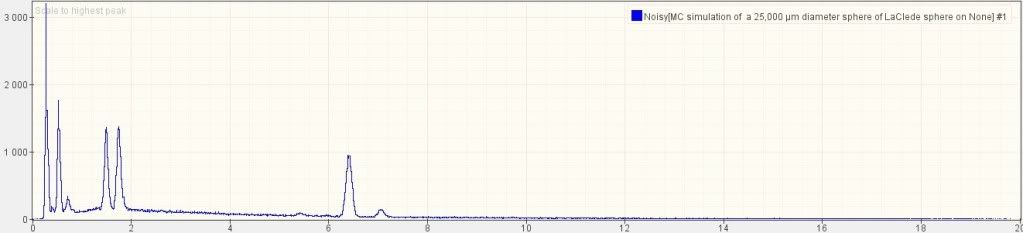
Using DTSA-II, a free multiplatform software package for quantitative x-ray microanalysis [7], I simulated a bulk sphere with the above chemical composition, using the same 20 keV that Harrit e.al. used:

The five larges peaks are, from left to right: C, O, Al, Si and Fe. Note the relative height: C is nearly twice as high as O; O is higher than than Al and Si; Al and Si are nearly equal; Fe is perhaps 70% of Si. Note that there is a small bump for Cr (chromium) at 5.4 (keV) on the x-axis, but none for Sr (strontium). The reason why strontium is invisible is that its main peak would be nearly exactly where the Si peak is, so it is hidden under the much larger Si signal.

We have estimated that the total painted surface area of the LaClede floor joists was about 600,000 m2 in both towers combined, or 50% more than the surface area of the exterior columns that were painted with Tnemec.

Discussion

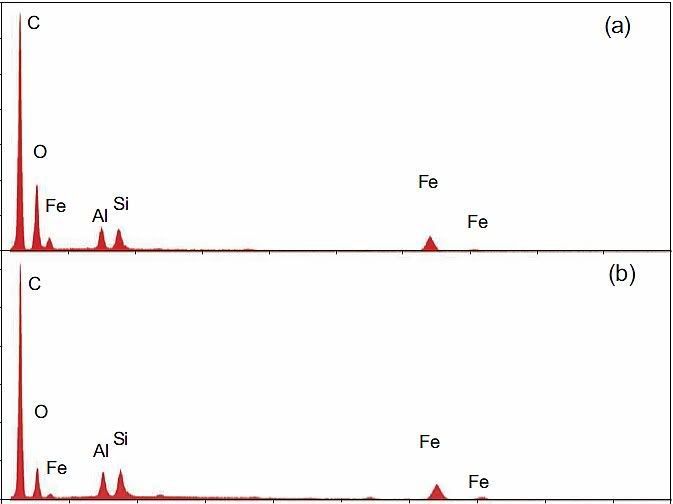
Compare the XEDS graph of LaClede primer with Harrit's chips (a)-(d):


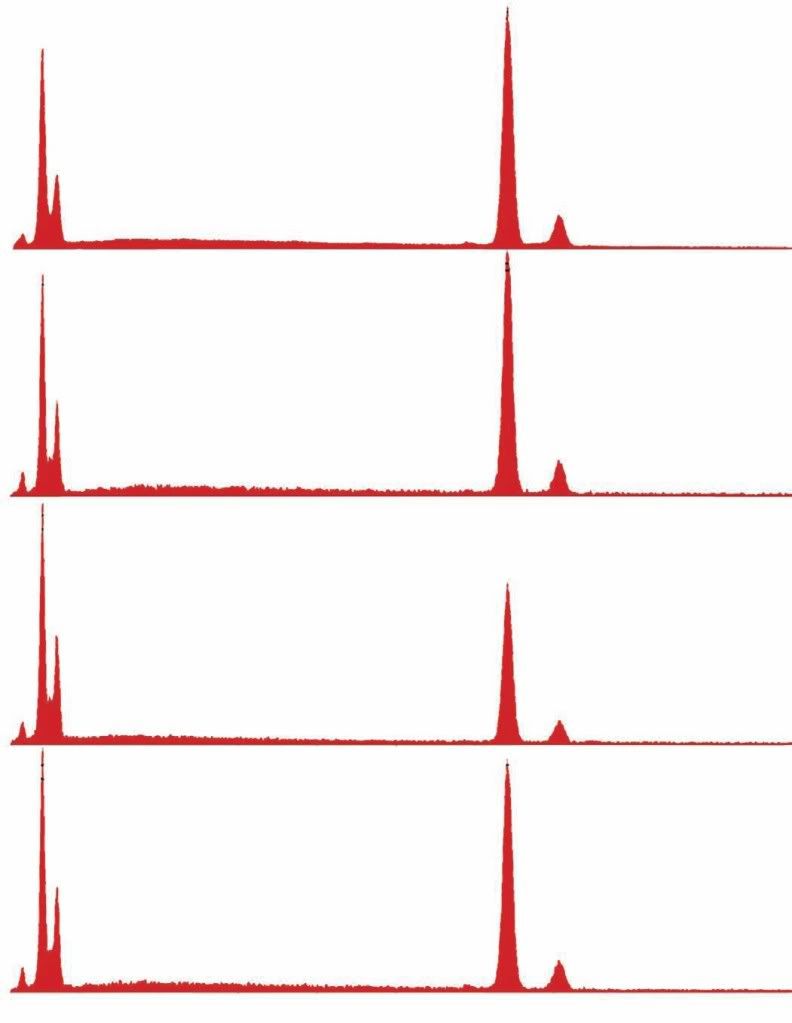
Now notice: C is again the highest peak by far, O is second in three of the four chips. Al and Si are nearly the same, Fe is typically about 70% of Si. And there is a small bump at 5.4 keV in chips b and d, which is chromium!

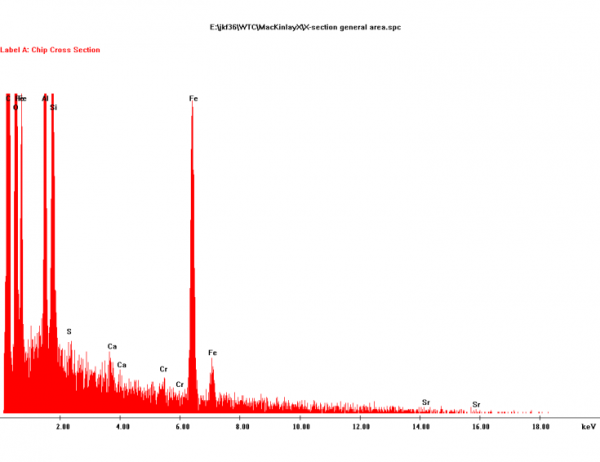
In [1], Harrit presents a more detailed XEDS graph for chip (a):

Do you see how Harrit has detected Cr (chromium) and even Sr (strontium) in trace amounts? Yep, there are also signals for S and Ca. Perhaps a tiny inclusion of gypsum, but I wouldn't bet on that.

Conclusion

I have shown that Harrit's argument, re-gray chips (a)-(d) can't be primer because they are not consistent with Tnemec, falls flat on its face, because Tnemec was not the only primer used on WTC steel. Another primer that must be considered is LaClede Standard Primer, and there could be even other primers of which no documentation seems to exist (we don't know for example which primer, or primers, was painted on the core columns and beams).

I have further shown that the XEDS spectra of chips (a)-(d) are very much consistent with the the paint formulation of LaClede Standard Primer.

I call on all honest and science-minded people in the 9/11 Truth Movement to reject Harrit's claim that chips (a)-(d) can't be primer as premature and consider LaClede Standard primer as a possible source for some of the red-gray chips. Tnemec may be another such source of other chips; in fact it seems that the MEK-soaked chip in [2] is consistent with Tnemec, as I have shown in another post [8] – this MEK chip can't possibly be identical with chips (a)-(d)! [9].

I further call on all students of [2] to realize that Harrit e.al. have analysed several different kinds of red-gray chips, and not pretend they are all basically the same.

References

[1] Niels H. Harrit: Why The Red/Gray Chips Are Not Primer Paint. Open Letter, May 2009

[2] Niels H. Harrit, Jeffrey Farrer, Steven E. Jones, Kevin R. Ryan, Frank M. Legge, Daniel Farnsworth, Gregg Roberts, James R. Gourley and Bradley R. Larsen: Active Thermitic Material Discovered in Dust from the 9/11 World Trade Center Catastrophe. The Open Chemical Physics Journal, 2009, 2, 7-31

[3] Carino, N. J.; Starnes, M. A.; Gross, J. L.; Yang, J. C.; Kukuck, S. R.; Prasad, K. R.; Bukowski, R. W.: Passive Fire Protection. Federal Building and Fire Safety Investigation of the World Trade Center Disaster (NIST NCSTAR 1-6A). 2005. Page 87: “...Series 10 Tnemec Prime (99 red), which is the primer that was specified for the exterior columns”

[4] Luecke, W. E.; Siewert, T. A.; Gayle, F. W.: Contemporaneous Structural Steel Specifications. Federal Building and Fire Safety Investigation of the World Trade Center Disaster (NIST NCSTAR 1-3A). 2005. Table 3-5, p. 21

[5] Gross, J. L.; Hervey, F.; Izydorek, M.; Mammoser, J.; Treadway, J.; Fire Resistance Tests of the Floor Truss Systems. Federal Building and Fire Safety Investigation of the World Trade Center Disaster (NCSTAR 1-6B). 2005. Appendix B, p. 157 of the PDF

[6a] AE911Truth Staff: FAQ #7: Aren’t the Red-Gray Chips Identified in the WTC Dust Merely Primer Paint from the WTC Steel Structural Elements?. Architects & Engineers for 9/11 Truth, 2012/03/15. Retrieved 2012/03/16

[7] Chuck Fiori, Carol Swyt-Thomas, and Bob Myklebust: DTSA-II Desktop Spectrum Analyser. Retrieved 2012/03/15

[8] Oystein: Steven Jones proves primer paint, not thermite. 2011/03/31

[9] Oystein: Why red-gray chips aren't all the same. 2012/03/14

Wednesday, March 14, 2012

Why red-gray chips aren't all the same

Abstract

Ever since Harrit e.al.'s paper "Active Thermitic Material discovered" (ATM, [1]) was published in April 2009, the world of 9/11 debaters (a small world, by the way) was split into two camps:

  • 9/11 Truthers who believe all the chips are super-secret high-tech military-grade beast of extremely energetic nano-thermite. Note the stress on „all the chips“

  • Skeptics who see that the chips are not all the same, are not thermitic, but very probably different kinds of paint instead.

In this post I will show that one particular chip in ATM, the one they soaked in MEK and present in Fig. 12-18, cannot possibly the same kind of material as the four chips they present in Fig. 2-11. Assuming that both represent the same material is preposterous. The most benign explanation for why the authors make that assumption is wishful thinking. We can rule out simple error or that they overlooked something, because it has been pointed out to them more than once in the past that the chips are different. A less benign, but perhaps more probable explanation would be outright fraud.

Visual comparison

Here are the chips I am talking about – first, the four chips they first present. I usually refer to them as chips (a)-(d):

Photobucket

As you can see, the red layers all look pretty much like they could be the same stuff, perhaps paint. Color is very similar, finish is very similar. Same goes for the gray layer, which could be metallic for all we know (and yes, Harrit e.al. figure out correctly that the gray layer is a bulk of oxidized iron). Notice that we can see and roughly measure the thickness of the red layer in the inset of Fig 2(d): It is roundabout 15µm thick.

Next up, the MEK-chip:

Photobucket

Whoa – what's up there?? The photo is totally out of focus! So yeah it is generally some kind of red and there seems to be some gray on the right, but does it have the same finish as (a)-(d)? Frankly, I can't tell! How thick is the layer? We can't tell from the photo, but Harrit e.al. included another image. In the following, the chip is shown after they had soaked it in a solvent called MEK for 55 hours.

Photobucket

They explain on page 17:

The red layer of the chip was found, by visual inspection, to have swelled out from the gray layer by a factor of roughly 5 times its original thickness.

In Fig 12(b), the red layer, on the left, is between 250 and 300 µm thick, aproximately, so before soaking it was 50-60 µm. Quite a bit more than the 15 µm of the red layer of chip (d) above, eh? (In Fig. 5, it is possible to roughly measure the thickness of the red layers of chips (a) and (b): approx. 32 and 13 µm respectively). So does that MEK chip look the same as the others? Hmmmm maybe, maybe not. Maybe not.

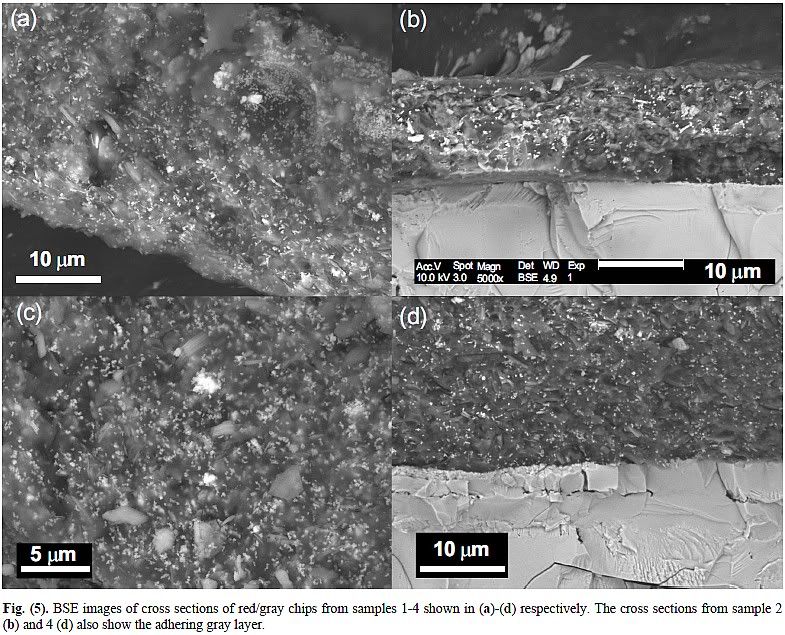
Harrit e.al. show high-magnification BSE (a form of electron microscopy) images for chips (a)-(d) in Fig. 4, Fig. 5 and Fig 8, where you can see the grains (identified by Harrit as hematite) and platelets (almost certainly kaolin, a natural clay) in the organic matrix. Unfortunately, no such BSE images exist for the MEK-chip, so we can't compare it to chips (a)-(d). The only other data we have is XEDS.

XEDS spectra

An introduction to XEDS (SEM-EDS)

(You may skip this section if you are not interested in technical details of this method)

XEDS (X-ray energy dispersive spectroscopy, also abbreviated SEM-EDX, see Wikipedia [2]) is

...an analytical technique used for the elemental analysis or chemical characterization of a sample. […] a high-energy beam of charged particles such as electrons or protons (see PIXE), or a beam of X-rays, is focused into the sample being studied. […] The number and energy of the X-rays emitted from a specimen can be measured by an energy-dispersive spectrometer. As the energy of the X-rays are characteristic of the difference in energy between the two shells, and of the atomic structure of the element from which they were emitted, this allows the elemental composition of the specimen to be measured.

In an XEDS graph, the location of a peak along the x-axis identifies a chemical element, while the height of the peak along the y-axis is indicative of the relative abundance of the element in the sample. Please note first that equal peak heights of two different elements do not automatically mean same abundance, although this is roughly true for many elements (for example, it is true for aluminium and silicone), but not all (for example, if strontium and chromium were equally abundant by mass, then the first peak of strontium at 1.81 keV would be only about 75% the height of the chromium peak at 5.41 keV. This is also dependent on factors like “accelerating voltage and/or contaminating surface films” [3]). A second note: The lightest elements, from hydrogen (1H) typically to beryllium (4Be) don't show up at all in an XEDS graph (depending on the device, not even up to carbon or nitrogen). The next lighter elements up to chlorine (17Cl) only have one peak associated to them. Starting with potassium (18K), more than one peak may show up, but in most cases, only one or two are dominant. Last note: Peak height scales with abundance. So if you double the abundance of, say, silicone in your sample, the Si-peak will be twice as high (roughly). If you want to look up only which elements have peaks at which energy levels (measured in keV – kilo Electronvolts), you may refer to [4]. Just klick on the element symbol you are interested in, and look in the column “Edge Energies”. Usually, the K-alpha level is your first major peak, K and K-beta for secondary peaks. Elements heavier than arsenic (33As) don't have important K-levels below 10 keV and are more usually identified by L-alpha or L-beta.

The spectra of Harrit e.al.

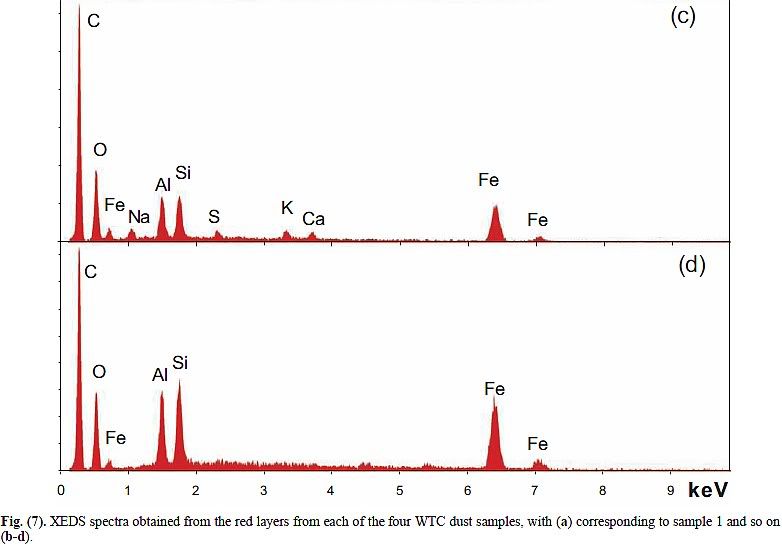
Harrit e.al. provide XEDS spectra for chips (a)-(d) in Fig. 7, and a spectrum for the MEK-chip (before soaking) in Fig 14. Let us first take a close look at all the peaks in Fig. 7 (shown below) and see if these four graphs are similar enough so we can be confident that all four show the same material. All have major peaks for 5 chemical element (from left to right, the major peaks: Carbon (C), oxygen (O), aluminium (Al), silicone (Si), iron (Fe)). In figure 7(c), Harrit e.al. have also labelled small peaks of natrium (Na), sulfur (S), potassium (K) and calcium (Ca). In addition, we think there are tiny but discernable signals for S and Ca in (a) and (b) as well, for chromium (Cr, K-alpha = 5.41 keV) in (a), (b) and (d), and titanium (Ti, K-alpha = 4.51 keV) in (d). While the small peaks could always be some sort of contamination (either on the surface, or of the minerals contained in the chips; for example, kaolin usually has small inclusions of Ti and Ca), the major elements do show up in comparable relative peak heights:

  1. In all four chips, C is by far the highest peak, being several times (2.85x to 7.45 time, average 4.3 times) as high as the second highest, peak, O

  2. O is the second highest in 3 graphs, and barely beaten by Si in 1. O has between 85% and 300% the peak hight of Si (average: 161%)

  3. Si and Al follow in third and fourth place, at almost the same hight. Al has between 87% and 110% the peak hight of Si (average: 96%). This result is consistent with both elements appearing in equal molar amounts.

  4. Fe (K-alpha) is always the fifth-highest peak, reaching between 51% and 81% of Si (average 70.5%)

  5. Note that none contain zinc (Zn) or magnesium (Mg), and all have at most traces of Ca and S

Here is Fig. 7:

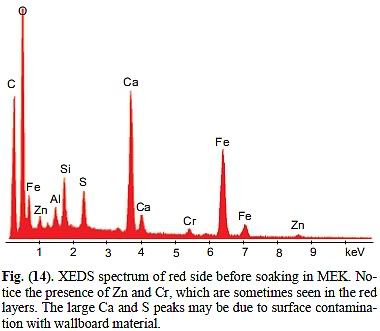
Now compare this to the MEK-chip, Fig 14:

Photobucket

It is very obvious that none of the characteristica of Fig. 7 are found here: For starters, Al is not among the 5 or 6 highest peaks, it is only number 7. Instead, Ca clocks in as the sceond highest peak. So let's go through the list item by item:

  1. C is not the highest peak, it is only the 3rd-highest. Instead of being at least 2.8 times as high as O, it has only about 60% of the height of O.

  2. O is much too abundant – relative to C (and, coincideltally, to Al) by a factor of at least 4.7

  3. Si and Al are not about equally abundant. Si-peak is too high relative to Al by a factor of 1.8

  4. There is way too much Fe relative to both Al and Si: Fe should be near 68% of Al, but it is actually 2.75 times as high. This means, too abundant by a factor of 4.

  5. The Ca peak is HUGE, it should only be a trace. The S-peak is BIG, it should at most be a trace. There should be no Zn at all. There is a peak between Zn and Al that Harrit e.al. did not label, but which certainly represents Mg. There should be no signal for Mg.

Discussion

How do Harrit e.al. explain these differences between Fig 7 and Fig 14? Here's how (page 17):

The resulting spectrum, shown in Fig. (14), produced the expected peaks for Fe, Si, Al, O, and C. Other peaks included calcium, sulfur, zinc, chromium and potassium. The occurrence of these elements could be attributed to surface contamination due to the fact that the analysis was performed on the as-collected surface of the red layer. The large Ca and S peaks may be due to contamination with gypsum from the pulverized wallboard material in the buildings.

So pretty much all of the Ca, all of the S, 75% of the Fe, 80% of the O, 45% of the Si, all of the Zn, all of the Mg is contamination? Gypsum, eh?

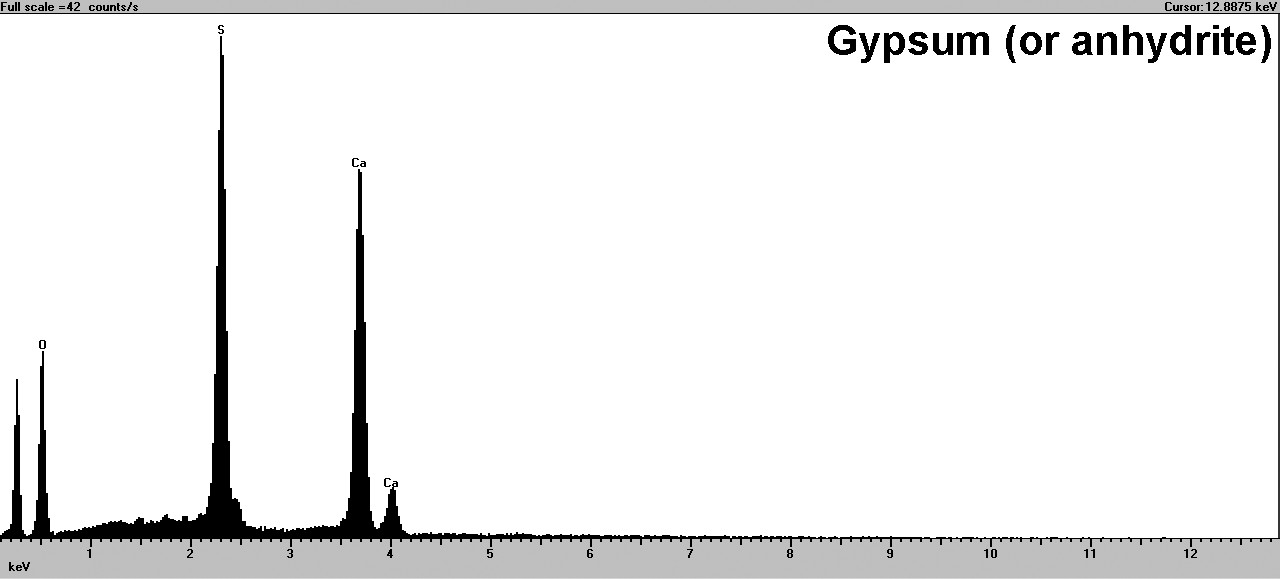
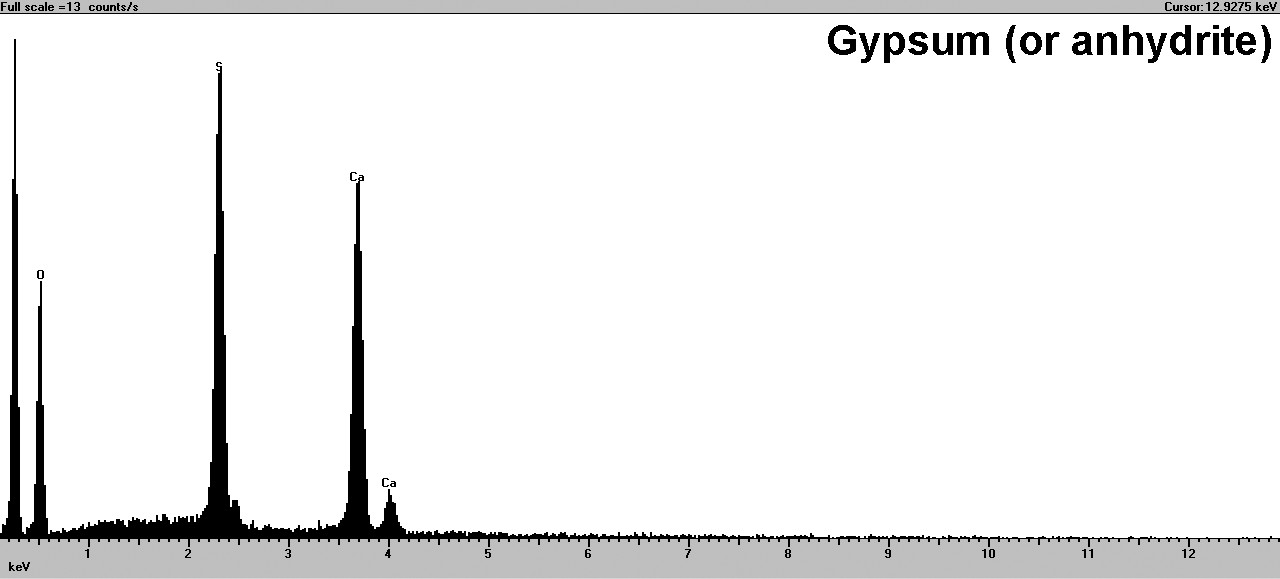
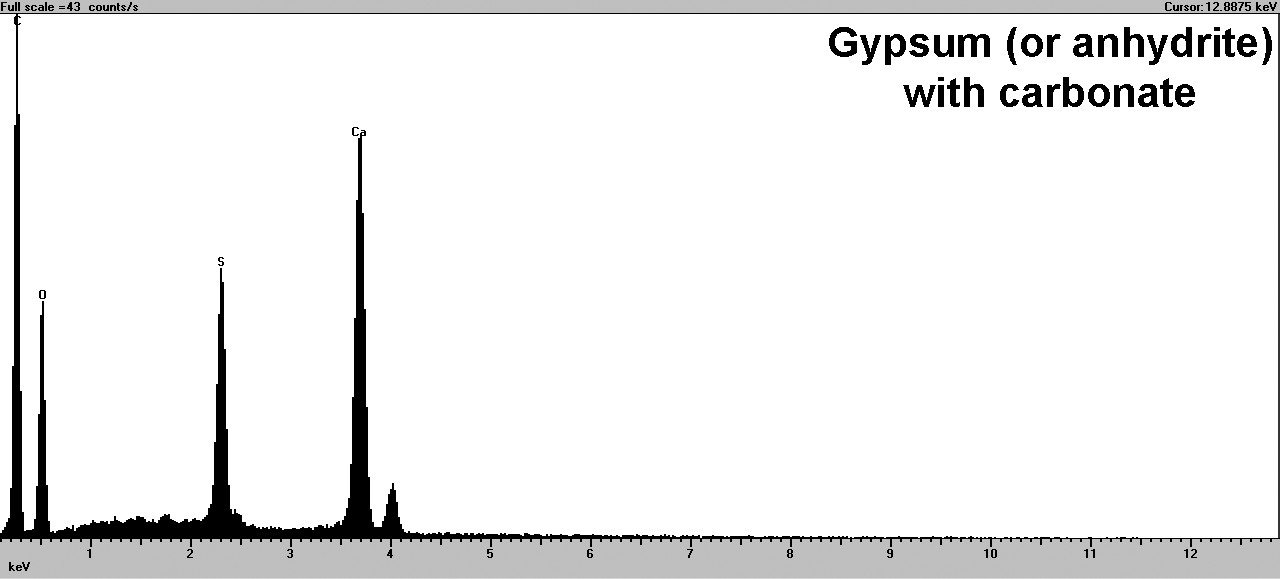
Here are three XEDS graphs for gypsum from the WTC [5]: Gypsum-01, Gypsum-02, Gypsum-03

Note that in the first two of the graphs, S peak is higher (by about 35% and 32%) than Ca, and in the third, which also has (calcium-?) carbonate, S is 33% lower than Ca. McCrone ([3] page 638) has S about 9% lower. This is to be expected, as the chemical formula for gypsum is CaSO4·2H2O - notice how Ca and S both have one atom in that molecule, their molar abundance is equal, their atomic weight is not much different (S: 32; Ca: 40; that's a ratio of 1:1.25). So, if you assume that gypsum is a major contaminant in Fig. 14, you must take off as much (+/- 33%) S as Ca – until you run out of S. Now, in Fig 14, Ca is 3 times as high as S. If you claim all of the S is from gypsum, and you remove all of it, and If I grant you that you may remove 33% more Ca than S, then the Ca peak is still almost as high as Fe, and higher than Si and Al. And the Fe-peak is still too high relative to C and Al, Si is too high relative to Al. So obviously, even if gypsum explaines all of the “contamination” with S, it would still constitute only a minor part of all of the “contamination”. In fact, to make Fig. 14 look similar to Fig. 7, you must

  • remove 80% of the oxygen (highest peak)

  • remove 95% of the calcium (2nd highest peak)

  • remove 75% of the iron(4th highest peak)

  • remove 45% of the silicone (5th-highest peak)

  • remove 95% of the sulfur (6th-highest peak)

  • remove all of the Zn

  • remove all of the Mg

  • remove most of the Cr

In other words: On average you must declare two thirds (65%) of the six most abundant elements to be contamination.

This is absurd. Preposterous. Wishful thinking. If not fraudulent.

Conclusion

A much better explanation is in order: Since no data exists, other than the base color and magnetic attraction, that shows that the MEK-chip is the same material as chips (a)-(d), since the visual appearance is doubtful, since the layer is too thick, and since the XEDS data shows that at least 65% of the mass of this chip is different from chips (a)-(d), the best and obvious conclusion is:

The MEK-chip is of a different material than chips (a)-(d). The assumption that the differences can be explained as contamination does not survice scrutiny and must be firmly rejected.

References

[1] Niels H. Harrit, Jeffrey Farrer, Steven E. Jones, Kevin R. Ryan, Frank M. Legge, Daniel Farnsworth, Gregg Roberts, James R. Gourley and Bradley R. Larsen: Active Thermitic Material Discovered in Dust from the 9/11 World Trade Center Catastrophe. The Open Chemical Physics Journal, 2009, 2, 7-31

[2] Energy-dispersive X-ray spectroscopy. Wikipedia, retrieved 2012/03/14

[3] Walter C. McCrone and John Gustav Delly: The Particle Atlas Edition Two, Volume III: The Electron Microscopy Atlas. Ann Arbor Science Publishers Inc., 1973, page 579

[4] Illinois Institute of Technology: Peridiodic Table. Last retrieved 2012/03/14

[5] US Geological Service: Particle Atlas of World Trade Center Dust. Open-File Report 2005–1165: On-line Report, öast retrieved 2012/03/14